

Together with Our Business Partners
At the Nippon Soda Group, compliance and other matters to ensure the execution of sound corporate activities are set forth in the Nippon Soda Group Code of Conduct, and we strive for thorough compliance with laws and ordinances. Furthermore, in addition to conducting fair and impartial transactions as a member of international society, we aim to build a sustainable supply chain that is environment- and society-friendly based on constructive dialogue with our business partners.
- Stance on transactions
We engage in dialogue with good sense and integrity, basing our transactions on fairness and impartiality.
In addition, we place the safety and health of our business partners who handle chemical substances as our top priority. As such, we are committed to providing appropriate safety information and safety training.
Working hand-in-hand with our business partners, we make continuous efforts to improve our quality and supply systems from raw material procurement to product delivery. - Purchasing activities
Regarding the procurement of raw materials and other purchasing activities, we strive to build and maintain stable relationships of trust with our suppliers based on our Purchasing Policy. We also collaborate with suppliers to address environmental and social issues within the supply chain based on the Nippon Soda Group Sustainable Procurement Guidelines. In addition, we take measures to prevent international human rights violations, such as child labor, forced labor, and human trafficking, working with our business partners to promote respect for human rights throughout our supply chain.
Initiatives in Purchasing
Purchasing policy
- Thoroughly comply with purchasing laws and ordinances (Antimonopoly Law, Act against Delay in Payment of Subcontract Proceeds, Etc. to Subcontractors, etc.). Participate in internal and external training regarding law and ordinance expertise. Select suppliers who comply with laws, regulations, and social norms in each country and region.
- Purchase raw materials that contribute to stable production and enhanced cost competitiveness.
- Promote environment- and society-friendly raw material procurement.1,2
- Secure multiple material procurement sources and undertake appropriate inventory management to ensure a robust business continuity plan (BCP).
-
1. Environment friendly
Includes the promotion of climate change countermeasures, including the reduction of GHG emissions; the prevention of environmental pollution; the protection of global and regional environments, including the maintenance of biodiversity and ecosystems; the promotion of resource- and energy-saving measures; and the reduction of waste. -
2. Society friendly
Includes the elimination of child labor, forced labor, excessive labor, and discrimination; respect for freedom of association and the right to collective bargaining; the protection of workers’ rights, including matters related to equal opportunity, minimum wage, and living wage; and the guarantee of safe, hygienic workplace environments.
The Nippon Soda Group Code of Conduct
At the Nippon Soda Group, we ensure thorough compliance with the Nippon Soda Group Code of Conduct, which outlines the following standards for transactions with suppliers.
- When selecting a supplier from among multiple vendors, we determine the most appropriate business partner by comparing and assessing quality, price, delivery period, technical capability, supply stability, and other criteria in a fair and just manner.
- When outsourcing manufacture to an external business, we only conclude contracts and complete transactions following thorough understanding of the Act against Delay in Payment of Subcontract Proceeds, Etc. to Subcontractors.
Cooperative purchasing activities
We engage in purchasing activities while checking the safety and environmental and social impact of our chemical products from manufacture to delivery. This includes collecting information from trading companies, who serve as intermediaries, and on-site audits alongside the quality control departments of each of our plants.
Through the exchange of diverse information, we are working to build relationships with our business partners that facilitate mutual development, and aiming to ensure sustainable procurement activities by cultivating deeper cooperation and understanding of our purchasing policy.
Raw material quality management
- We regularly visit suppliers of pharmaceutical raw materials to conduct GMP* audits.
- For all other raw materials, we implement regular paper-based audits of our suppliers, and check whether there have been any changes to product standards, manufacturing processes, and raw materials used from the details in the purchase specification sheet.
- * When manufacturing pharmaceuticals, it is important not only to check conformity with predetermined quality standards but also to appropriately manage the manufacturing process itself to ensure consistent manufacture of high-quality pharmaceuticals. Good Manufacturing Practices (standards for pharmaceutical manufacturing and quality management) are a set of requirements for the manufacture of high-quality pharmaceuticals.
Environment- and society-friendly supply chain
- The Nippon Soda Group has formulated the Sustainable Procurement Guidelines with the aim of promoting understanding of our Group’s policies and values among our suppliers, and collaborating with them to address social issues. These Guidelines are for the following themes.
|
-
In addition, as part of its commitment to sustainable procurement, Nippon Soda began a supplier survey in February 2025 using the CSR/Sustainable Procurement Self-Assessment Tool (ver. 1.2) developed by the UN Global Compact Network Japan (GCNJ) to evaluate fulfillment of social responsibilities across the supply chain. In FY 2025/3, we had 36 raw material suppliers complete the survey, and the overall average score percentage1 reached 92.9%.
Through this survey, we determined what initiatives our business partners were implementing across the following nine categories: - Ⅰ.Corporate governance (e.g., CSR administration systems, internal controls, BCP, and internal reporting systems)
- Ⅱ.Human rights (e.g., respect for human rights, prohibition of discrimination, and avoidance of complicity in human rights abuses)
- Ⅲ.Labor (e.g., prohibition of employment discrimination, inhumane treatment, forced labor, and child labor)
- Ⅳ.Environment (e.g., chemical substance management, wastewater and emissions control, reduction of greenhouse gas emissions, waste management, and promotion of biodiversity)
- Ⅴ.Fair business practices (e.g., prevention of corruption, compliance with competition laws, and exclusion of antisocial forces)
- Ⅵ.Quality and safety (e.g., product/service quality and safety assurance and accident response)
- Ⅶ.Information security (e.g., protection of personal information and management of confidential information)
- Ⅷ.Supply chain (e.g., practicing responsible procurement and taking measures to avoid use of conflict minerals)
- Ⅸ.Coexistence with local communities (e.g., contribution to and collaboration with local communities)
- Based on the results of this survey, we will continue dialogue with business partners to promote CSR activities across the entire supply chain. We will continue to regularly conduct this assessment based on the Ten Principles of the UN Global Compact (covering the areas of human rights, labor, the environment, and anti-corruption) to build a sustainable supply chain that meets international standards.
-
When agreeing on purchase specifications with our material suppliers, we check for the acquisition of ISO 9001 and 14001, the presence or absence of conflict minerals,2 and any independent concentration management criteria in place at the material treatment location to protect workers’ health. In doing so, we ascertain the level of impact the material and its supply have on the environment and society.
Furthermore, regarding chemical substances that are subject to restrictions due to their impact on the environment, safety, and health, we aim for smooth information sharing across the supply chain, and request that suppliers provide information on contained materials using the chemSHERPA format.3
- 1. Average score ratio: the average of the ratios of actual scores to allocated points (percent score) across the nine evaluation categories.
- 2. Materials are checked based on the Conflict Minerals Reporting Template put together and provided by the Responsible Minerals Initiative.
- 3. A format promoted by the Joint Article Management Promotion-consortium to enable appropriate management of information on chemical substances contained in articles, etc., and ensure smooth disclosure and communication of said information across the supply chain to enhance industrial competitiveness.
Dialogue with Business Partners
Improve awareness on safety and disaster prevention together with our partner companies
We provide education on the safe use of agricultural machinery to companies to whom daily field maintenance is consigned at various agricultural fields under the jurisdiction of the Research & Innovation Centers.
In cooperation with our partner companies, we aim to achieve zero accidents by involving all relevant people. We implement various measures to raise awareness on safety and disaster prevention among employees of partner companies who work within our facilities, such as the development of a list that clarifies who has qualifications for operating agricultural machinery and equipment and the management of operations.
Educating transportation companies on logistics safety
The Nippon Soda Group regularly provides education targeting related transportation companies. Our programs not only provide training to prevent accidents caused by our workers and during transport, but also information on past complaints regarding logistics. We share such information to ensure the safe delivery of our products to our customers.
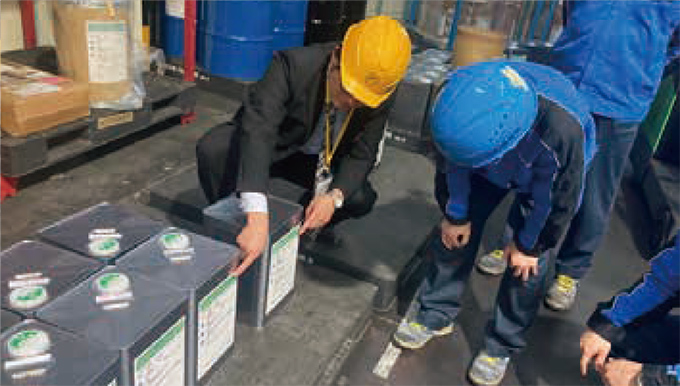
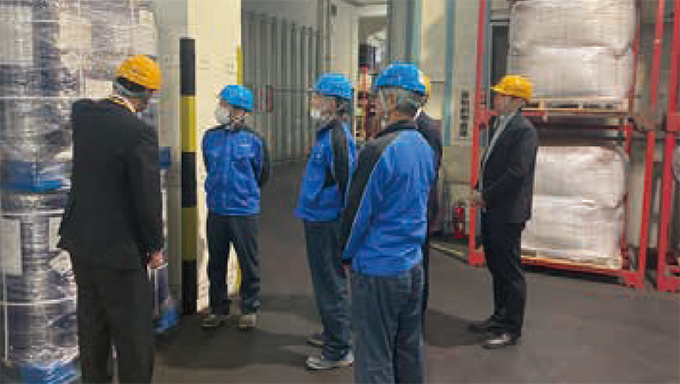
Logistics safety education
(classroom learning and training on how to handle product leaks)
(Omiya Distribution Center, Sanwa Soko Co., Ltd., October 28, 2024)
Declaration of Partnership Building
As we aim to create a sustainable supply chain, at Nippon Soda we are engaging in constructive dialogue with our business partners to promote environment- and society-friendly business activities.
Moreover, we are working with our supply chain business partners and value creation companies to ensure “co-existence and co-prosperity,” and as part of the Declaration of Partnership Building, announcing our key measures to build new partnerships.
- *Declaration of Partnership Building
https://ssl4.eir-parts.net/doc/4041/ir_material3/192602/00.pdf(Japanese version only)